2. The Virtual Reality Headset Called “Space and Time”
In the interview, Hoffman said: “… these [CA] are consciousnesses, interacting, that are not inside space and time; space and time will be inside some of these conscious agents, but probably not most. The idea that space and time is a headset, a VR / virtual game headset, that some conscious agents use to interact with others (and probably one of the more trivial headsets, probably one of the simpler headsets – it’s only three dimensions of space and one dimension of time; maybe eleven if you think String Theory, but most people aren’t going into String Theory these days)…”
For me this is an intriguing and useful view. Trying to integrate it with my imagined graphical representation of RSU, I think of it as a black box sitting somewhere in the CCA’s input region. In other words, it would be a sub-cluster of ECA’s (which can, in itself, be perceived as a more basic CCA) that is receiving “raw input” (meaning, essentially, “reality as it is”) and converting it into a space-and-time-based representation of reality, that is then fed downstream into the rest of the CCA, to mull on:
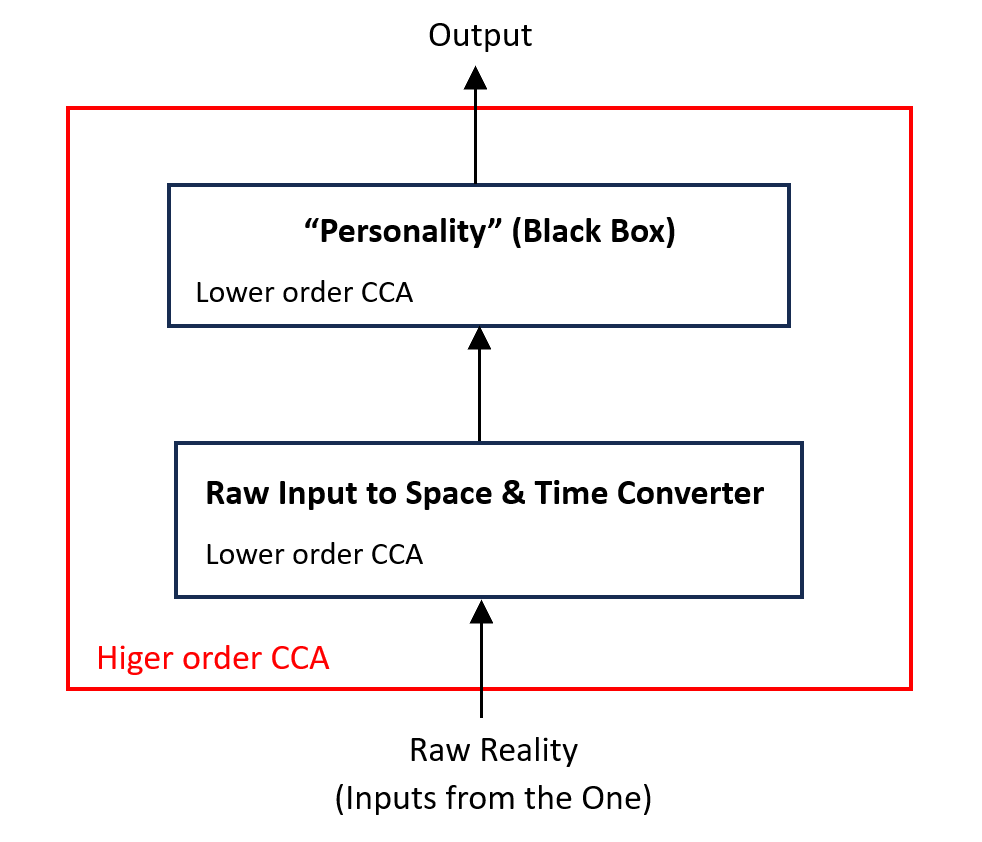
The higher order CCA in the diagram above (or more accurately, its “personality”) might not even perceive that it’s “using” a converter, or a headset in Hoffman’s terms; it might be fully convinced that what it receives is reality itself, because it has no access to to the raw input feeding into the converter (it doesn’t “see” it).
If we sign up to that view, as Hoffman goes on to elaborate, the challenge is to “generate space and time and everything in it“, including all of modern physics as currently known – relativity, quantum theory, basic sub-atomic particles and so on – from first CA principles. The way I understand that statement of his, is that we have the basic definitions of ECA at hand (in Hoffman’s team’s work these are precise mathematical definitions), complemented perhaps by some model of connecting and clustering (one possible example is my own speculations), and we need to somehow show/prove – mathematically – that from these building blocks a complex, working structure such as the Raw Input to Space & Time Converter (lets call it RIST converter for short) can be constructed; and that “viewed” from the downstream side – that’s our perception, looking into the headset – it would look like the world “as we know it in space and time” (including essentially all of modern physics). To me that makes sense, because I suggested above that the RIST converter is nothing but a CCA (the reason for suggesting that is simple – any complexity in existence, in RSU, is a CCA).
And now… drum roll… according to Hoffman, this is already happening in research! Not only in his team, and not even very recently. It turns out that while the majority of physicists still preach that Spacetime is fundamental, a new branch in physics has been picking up speed since 2013. Apparently there are more than a handful of modern day physicists willing to consider that space and time are not fundamental to reality, and they discovered new theoretical structures (with fancy names that I will spare you), that are apparently useful. “Useful” here means that those structures/theories allow calculated predictions of aspects of elementary particle interactions. Those predictions are apparently good (I’m guessing they are in good alignment with experimental results); they do not rely on space, time, Relativity or Quantum Theory; and the calculations are (according to Hoffman) “much quicker and cleaner” than the more traditional ones, which are based on Spacetime.
If I understand Hoffman correctly, this is an indication of (possibly) “things happening somewhere outside Spacetime”, in an abstract way that is fundamentally different to the way physicists used to think about them; and then these things project into Spacetime. This last expression means that Spacetime is like a screen (as a metaphor); more generally, it is something that when subjected to an influence will respond to generate a certain “presentation” of that influence. It is like a cinema screen: The source is in the projector, which we don’t see; we don’t see the light rays travelling to the screen either; only when they hit the screen, an effect is generated, and the images that originated in the projector show up as if they are “happening on the screen”. Obviously, we know that they don’t originate in or on the screen. It’s just a projection.
The only “difficulty” with the new theories is that they are static – they describe a certain state (point in time, if we relate to the projection into Spacetime), so they fall short if we want to study processes or things that develop, one out of another. Coming back to the projector metaphor, it’s the equivalent of a single slide projector (rather than a movie). Hoffman’s team of collaborators is working on different (or supplemental) theories, where the source of all things is also outside Spacetime, yet these theories have a dynamic aspect (Markovian dynamical systems). In other words, they allow change, and hence processes and development. Apparently there are some promising breakthroughs in that direction, though Hoffman admits that the work is not yet complete.
That’s it for today. Peace to all.
 The Meaning of Life and Other Vegetables
Leave a comment